What Is Vibe Coding? The 2026 Deep Dive for Solo Builders
Vibe coding is the practice of shipping real software by steering AI tools with taste instead of typing every line yourself. The complete 2026 guide — what it is, what it isn't, the workflow, the stack, the pitfalls, and the way it actually works.
Vibe coding is the practice of building software by describing what you want in natural language and steering an AI tool toward the result, instead of typing every line by hand. You stay in control of the outcome — taste, architecture, edge cases — but the AI handles the keystrokes. It is the default workflow for a growing slice of solo founders, indie hackers, and designers-who-ship in 2026.
The term was popularized by AI researcher Andrej Karpathy in early 2025. By mid-2026 it has stopped being a buzzword and started being how a lot of real software gets shipped.
This is the deep guide — the workflow, the stack, the failure modes, the parts that work, and the parts you should not believe.
TL;DR — vibe coding in 2026
- Definition: Build software by describing intent and steering AI output, rather than authoring every line manually.
- The skill: Knowing when AI output is good, when it is wrong-but-harmless, and when it is wrong-in-a-dangerous-way.
- The stack: An AI-native editor (Cursor or Claude Code), a fast scaffolder (v0.dev, Bolt.new, Lovable), a hosting platform (Vercel), and a strong "do not paste secrets" hygiene habit.
- The market: $4.7B in 2026, projecting $12.3B in 2027. Marketing teams and SMEs are the fastest-growing segment, not just engineers.
- The risk: AI-generated code carries 2.74× more security vulnerabilities than handwritten code on average. Read every line.
- The whole game: Taste, judgment, and willingness to push back when the model produces slop.
What vibe coding actually is
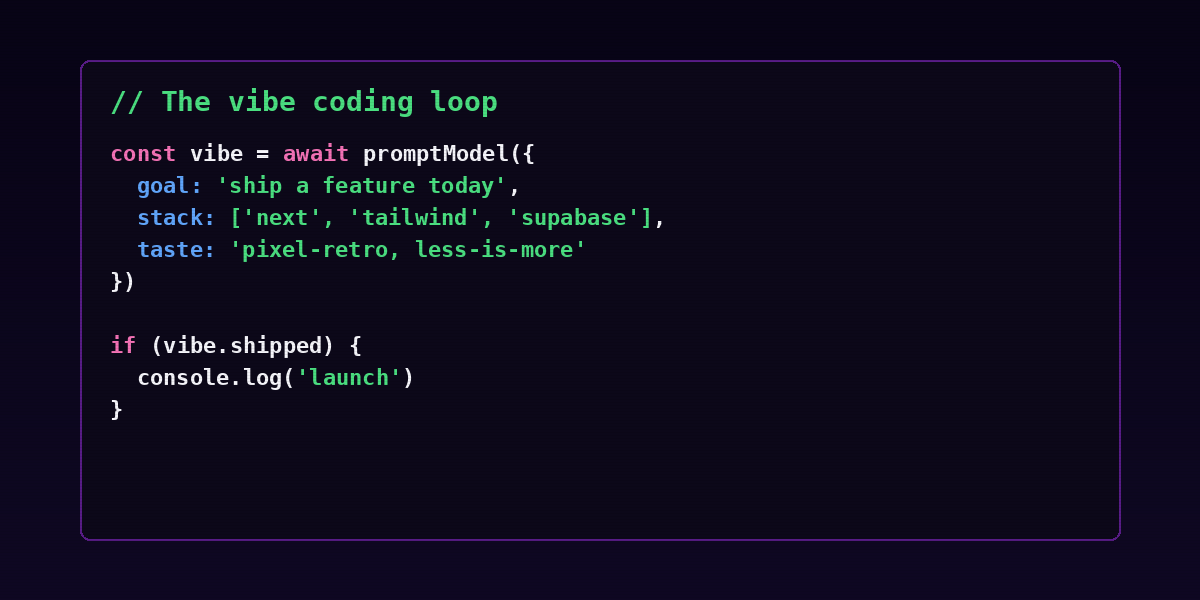
Vibe coding is a loop, not a magic button. The four steps:
- You describe the outcome in plain language — "build a settings page with email + password change."
- An AI tool proposes code — full files, diffs, or scaffolds.
- You read, run, and react — "no, more retro," or "this component has three useEffects, collapse them," or "do not install that package."
- The model revises. You ship.
The skill is not typing. The skill is taste — knowing when output looks right but is structurally wrong, when a function it cited does not exist, and when a "safe default" hides a dangerous assumption.
Vibe coding vs AI-assisted engineering
These are often used interchangeably. They are not the same.
- AI-assisted engineering is what an experienced engineer does when they use AI to accelerate their existing workflow — autocomplete, test generation, code review. The engineer is the primary author. The AI saves keystrokes.
- Vibe coding flips the ratio. The AI is the primary author. The human is the director.
If 80% of the lines you ship were typed by you, you are doing AI-assisted engineering. If 80% were generated and curated, you are vibe coding. Both are valid. Pick the one that matches the project.
Vibe coding vs no-code
No-code platforms (Webflow, Bubble, Softr) let you build by clicking. They hit a wall the moment you need a third-party API call the platform did not anticipate, or a custom rule that does not exist as a block.
Vibe coding has no wall. The output is real code in real files. When you hit something the AI cannot do, you write the part by hand and continue. No-code's ceiling is the platform's feature set. Vibe coding's ceiling is your judgment.
The vibe coder's day, in detail
A real day looks like this:
Morning (the planning loop). Open your editor. Describe the feature in three sentences in a chat with Claude Code or Cursor's composer. Ask for a plan, not code. The model responds with "I would touch these four files, in this order." You read it. You correct things ("no — use the existing auth helper, don't write a new one"). You approve.
Late morning (the execution loop). The model edits files. You watch the diffs. You commit each logical change in its own commit so git is your undo button. If something feels off, you reset hard and re-prompt rather than pile on top of a confused state.
Afternoon (the verification loop). You run it. You poke at the edges — what happens if the API fails, what happens if the input is empty, what happens on mobile. The model is great at the happy path. It is unreliable at edge cases unless you explicitly ask for them.
End of day (the shipping loop). You commit, push, watch the deploy, click the live URL, and ship a version to one user.
Repeat that loop, and you ship more real software in a quarter than most engineers ship in a year.
What vibe coding is NOT
A list of common misconceptions, in 2026:
- "AI replaces engineers." It does not. It compresses the time between intent and shipped software, but the judgment that decides what to build and whether the output is correct stays with a human.
- "You don't need to read code." You absolutely do. Models confidently invent functions, cite deprecated APIs, and reach for libraries that do not exist. If you cannot read the diff, you cannot ship safely.
- "It's just no-code with a different UI." It is not. The output is real code in real files that you own and can modify, fork, or rip apart at any time.
- "It's the end of programming as a profession." It is not. It is a leverage shift. The engineers who learn this workflow are becoming 3-5× more productive on the right tasks. The work moves up the stack — toward judgment, architecture, and integration.
- "It only works for prototypes." Increasingly false. Production codebases at small companies are now substantially vibe-coded. The line is drawn at the review process, not the authorship.
The 2026 vibe coder's stack
The full stack of tools shipping software in 2026 is shorter than people think.
Editor and agent
- Cursor — VS Code-shaped IDE with AI baked into every surface. Best for UI-heavy work where you want code and preview side by side. See our Cursor vs Claude Code comparison for the full breakdown.
- Claude Code — Terminal-native agent. Best for multi-file refactors, test generation, and "fix this failing test and run it" tasks where you want to walk away.
- Windsurf, Zed Chat, GitHub Copilot Workspace — strong alternates, all converging on the same shape.
Scaffolding
- v0.dev — landing pages, marketing sites, polished UI. The output code is yours to take into your editor. See 10 v0.dev prompts that convert.
- Bolt.new — full-app scaffolds with backend in one tab. Fastest end-to-end MVP path.
- Lovable — opinionated app builder with the most polished defaults. Trade flexibility for cohesion.
- See the head-to-head: Lovable vs Bolt.new vs v0.
Backend, hosting, payments
- Next.js + Tailwind + shadcn/ui — default frontend stack.
- Supabase — Postgres + auth + storage in one SDK.
- Vercel — push to git, deploy to URL in 45 seconds.
- Stripe Checkout — never build a payment form again.
- Full breakdown: The vibe coder's stack 2026.
AI infrastructure
- Anthropic API + OpenAI API — the two model providers most builders default to.
- OpenRouter — single endpoint across providers, useful for quickly testing models against the same prompt.
- [RapidClaw](https://rapidclaw.dev) — managed AI agent hosting when you want an agent running in Telegram, Discord, or WhatsApp without standing up a VPS.
How to start vibe coding this week
A concrete five-step path from "curious" to "shipped":
- Pick one AI editor — do not shop forever. Cursor or Claude Code, both excellent. Free trials on both. Day one is fine for a decision; week three is overthinking.
- Clone a small existing project you already understand. Models get lost in blank repos. They do their best work where there is structure to anchor against.
- Make one non-trivial change. Not "rename a variable." A real, user-visible feature. Read every line of the diff before accepting.
- Ship it to a real URL. Vercel's free tier is plenty.
yourapp.vercel.appis fine — custom domains can wait. - Tell one person it exists. This is the step everyone skips. It is also the step where you find out whether you built the right thing.
Repeat that loop ten times in a month. You will ship more real software than you did in the entire year you spent "learning to code" the old way.
The pitfalls — and how to dodge them
Vibe coding is not free. The failure modes are real and most of them are predictable.
1. Hallucinated dependencies
Models confidently suggest libraries that do not exist, or worse — typo-squatted packages that do exist and are malicious. Mitigation: "Do not install any new npm packages without asking first" goes at the top of every session prompt. We dive deeper in How to stop AI hallucinations when vibe coding.
2. Confident wrong code
Models produce code that compiles, runs, looks correct, and is subtly wrong. Mitigation: ask for tests with the feature, not after. Run the tests. Read the test code, not just the pass/fail signal.
3. Leaked secrets
The model context window is a security boundary. Pasting an .env file into a chat means that file may now be in training data, logs, or an analytics export. Mitigation: never paste raw secrets. Use placeholder values when you need to show shape. Treat the chat like a public Slack channel. See 13 vibe coding security mistakes.
4. Silent architectural drift
Each prompt-response cycle introduces small structural decisions. Twenty cycles in, the codebase has fifteen subtle inconsistencies. Mitigation: keep a NOTES.md or ARCHITECTURE.md and tell the model to read it at the start of every session. Be explicit about conventions ("we use server components by default, prove a reason before reaching for client").
5. The "I'm not really shipping" trap
The output of vibe coding feels less hard-won than handwritten code, so it is easier to keep tweaking and never ship. Mitigation: time-box. The 48-hour SaaS playbook is intentionally aggressive — see Ship a SaaS in 48 hours.
The market in 2026
A few numbers to anchor where this is in its arc:
- $4.7B — global vibe coding market size in 2026, per industry estimates.
- $12.3B — projected 2027 market size.
- 162% — year-over-year growth rate, 2025 to 2026.
- 2.74× — security vulnerability rate of AI-generated vs handwritten code (METR/GitClear/CodeRabbit research).
- 19% — productivity drop reported in some controlled studies — driven by reviewing/fixing AI output. The wins show up at the *project shipped* level, not the *line of code* level.
For more context on the numbers: Vibe coding statistics 2026.
The builders winning in 2026 are not the ones who type fastest or memorize the most APIs. They are the ones with the clearest sense of what good looks like — and the willingness to push the AI back until it gets there.
FAQ — vibe coding, answered
Is vibe coding the same as AI-assisted programming?
No. AI-assisted programming uses AI to accelerate a human-led workflow. Vibe coding flips the ratio — the AI is the primary author and the human is the director. Both are legitimate; they apply to different tasks.
Who coined the term "vibe coding"?
The term was popularized by AI researcher Andrej Karpathy in early 2025 to describe a workflow where you describe software in natural language and let AI handle the implementation, intervening only to steer.
Can I vibe-code production software?
Yes, with discipline. Production-grade vibe coding requires a code review process, automated tests, security scanning, and the same operational hygiene any production codebase needs. The rule is "AI authors the code; humans own the consequences."
Do I still need to learn programming?
Yes. You need enough programming literacy to read what the AI produces, judge whether it is correct, and intervene when it is wrong. You do not need to type fast. You do need to read fast.
What's the best AI tool for vibe coding in 2026?
There is no single best — Cursor and Claude Code are the most popular, with Windsurf and Zed Chat as strong alternates. Pick one, ship five projects, then evaluate whether you need to switch.
Is vibe coding dangerous for security?
It can be. AI-generated code carries roughly 2.74× more vulnerabilities than handwritten code on average, and AI tends to suggest insecure defaults (permissive CORS, hardcoded secrets in examples, unsanitized inputs). Mitigation is process — code review, automated security scanning, and explicit "do not commit secrets" prompts.
Will vibe coding replace developers?
Not in the foreseeable future. It is reshaping the work — moving developer time toward judgment, architecture, and integration, away from pure typing. Engineers who learn the workflow are getting more leverage, not less work.
How much does it cost to vibe-code seriously?
A reasonable monthly stack: Cursor or Claude Code ($20-40), Vercel (free for most projects), Supabase (free tier or $25/mo), domain ($12/yr). Call it $50-80/month plus your time. Cheaper than a single hour of contract development.
The bottom line
Vibe coding is not a shortcut. It is a leverage shift — a transfer of the time you spent typing into the time you spend thinking, deciding, and shipping. The builders who thrive in 2026 are the ones who treat the AI like a junior engineer who types fast: clear context, clear goals, visible work, and a short leash until trust compounds.
Pick one editor today. Build the smallest version of the thing tomorrow. Ship it on Sunday. Tell one person on Monday. Repeat for a year and watch what happens.
That is the vibe. That is the whole game.
---
Want to keep going? Read 30 real vibe coding examples for inspiration, the vibe coder's stack for 2026, the 48-hour SaaS playbook, or 13 security mistakes to avoid. For the career-side of this trend: vibe coder jobs and salaries in 2026. PMs and operators: vibe coding for product managers. For weekly coverage of the AI tooling space, our media partner is humanai.news. To deploy a personal AI agent in 60 seconds, RapidClaw.